Feminist research approaches in practice, Vijay Publications, 2020
The paper is based on gender sensitisation efforts with 600 children in a state school in Kumbakonam, Tamil Nadu. The ongoing action research initiates and provides a platform for dialogue around gender sensitisation and sexual harassment through workshops among parents, teachers and students. Based on the primary data collected during the sessions, the study focuses on students’ attitudes, perceptions and awareness on gender and sexual harassment issues in a small town. It makes a case to consider the sociocultural contexts and dynamics of the school, family and the local community. It elaborates on the attempt by researchers to contextualise the curriculum, pedagogical methods and tools of reflection according to the local context within the socio-economic, linguistic constraints and the reflective abilities of the participants. The paper also reasons why gender parity in education should go beyond enrolment rates or textbook representations. It also discusses why gender sensitisation programmes should consider involving parents to resolve gender parity issues and advocates for creating more spaces for intergenerational dialogue through gender sensitisation workshops in school
Okay, Now personal stories! Living up to my father’s dream from 10 years ago.
He told me, “Nee sociology padichitu, Jholna payi matitutu, Inthmari roadla kathitu oru nal urupadama po pora” (After studying sociology, you would one day stand on the road protesting with no money and ruin your life).
We have been talking about climate change and everyone knows the basic problem but grasping how big, deep and how urgent it is has been the problem. So I had discussed with students and I showed them videos of Greta and they were super motivated to do something! But these kids are really occupied. The school system is restrictive and it doesn’t leave any time for them to think and they are having exams now.
After some time, one of the kids suddenly volunteered and said he would take the responsibility to discuss and organise further actions and they came back with the idea on 19th September that they would protest between 7.00 am and 9.00 am on 20th September -.- -.- (I am no different from them. I do everything at the last minute but now I had to be on the other side! UGH)
So we shared information with whomever we could with our networks. They collected Rs.2 from their class and collected Rs.80 to buy charts etc and started cracking on the posters whenever they got a break from class. (Aren’t they cute?)
Now I had to go and get permissions to protest in a public place. After so much deliberation, they decided to do this and now excited and have spoken to their parents also! After consulting with different people, they tell me I need to secure permission from DSP(Police) requesting permission to protest. (But that’s not the procedure, go to your nearest station and submit a letter with details at least 3 days before the event). That’s when the long rules and procedures of this country bugs you and I don’t live in Kashmir and I am one of the privileged ones. I have participated in protests but have never been the one to get permission etc.
Okay so, need to get it. They warned me that I don’t have any org affiliation and its highly doubtful that I would get it.
Finally, I decide to visit the DSP’s office at 6 in the evening on 19th with a printed letter. The way town is different from a city is they would immediately ask me about my family and I had no intention to mention it to them, I was hoping that wouldn’t come up so I talk very less and act all naive and dumb. Being a girl helps in such places, they talk less to you 😉 so the other staff told me its impossible to get permission because it’s too late and it’s such a random group and told me that I have to go to some other station. We discussed and was hovering around. I finally asked one of the staffs to try and finally that guy wanted me to leave( Again, I think it’s because I am a girl and it was 7 pm) so he said, “I will show it to the DSP but he would say, “No”. I said,” Okay “.
I have no regard for authority in general and I have worked in govt offices yet I was intimidated and I was waiting restlessly outside!
Then the DSP called me inside!!
He had such a long nose and was sitting on the chair with a white towel and asked me the details and I told him it would be just 30-40 of us and it’s for Environment. (I am sure this is the least of their problems in the radar:P) And, he asked me what would we do there and I was warned not to use words like “strike” and “protests” to him so I said, “Support for global movement”. And, he again asked me so what would you do there, I said “Just showing support” he got irritated and told me giving notices, giving speeches, stage etc, what are we planning to do and Apparently, different things could require different permissions! and I told him it’s just going to be mainly for support/awareness so he changed the location from a public tank to Gandhi park and he said we could go ahead with that location! (In my mind, I was thinking this is wonderful, I need to tell Sujit) and he asked me so,
‘You are organising and you would be responsible?’
I am thinking in mind ( should say I say yes or no? Am I the adult now who should be taking responsibility for children? If something goes wrong, will I get arrested? I would rather die than got to jail, look at Chidambaram. Will the children be safe? How can I be sure?).
He is super irritated by now and asked me,
Yennama Sollu?
I said, “Yes”
(Lol, this is the kind of “Yes” I am saying in life:P )
Finally got permission and ran out grinning with excitement and murmured that I will see him soon again.
We (Sethulakshmi Vinayan and I) did a Gender and sexual harassment workshop in the school I studied in. It was a surreal experience to lecture the teachers on gender ( And, a few of them have asked me not to talk to boys in the past). Please refer to the write up below for the details on the workshop and I will share some interesting anecdotes.
Favouritism- teachers pointed out how all the cleaning tasks are assigned to girls while physical work like moving benches is assigned to boys. They acknowledged how they are reinforcing the stereotypical patterns. And how they hit boys more because they don’t react and when something goes wrong in classrooms their first reaction would be to taunt the boys.
Teachers said they face gender barriers in their workspace too. Like how they sometimes end up doing more writing work because they are told they doing it better than male teachers. They also mentioned instances like how women are the ones who stand throughout the day in the entrance of textile shops to welcome customers.
They also spoke about the restrictions they face despite working and earning. Like having to return at a particular time, being given only little pocket money though they earn their salaries. In a lot of families, their finances are still handled by their husbands or fathers.
What would you do if you are a man? We had usual responses like I want to roam at night. ( We might soon organise, loiter/ occupy at night kind of things ;))
Then there was this incidence- A group of boys making fun a girl in a classroom and the girl complained to the teacher how she was scared to confront them because she said the boys might start bullying her by puncturing the cycle etc
For the stereotypes found in textbooks, the suggestion that was discussed among teachers is although we can’t keep dealing with it regularly if we sensitise the students that there is discrimination in books and they might start seeing it themselves. And,at least find a pattern.
So much more to share.😅 I got so much satisfaction in playing movie scenes and asking them to identify the respective IPC sections for famous movies like Kushi scene with Vijay and Jyothika ‘en idupa pathiya’ to Rajini’s monologue to Dhanush’s stalking. Very therapeutic. And, it felt perfect because Sethulakshmi Vinayan and I watched Korean serials at night and swooned over guys and lectured people on gender the next day. In the coming days, we would be doing it with parents and students of the school.
In May 2021 a social media discussion on casteism and predatory behaviour in school and colleges snowballed into a #MeToo campaign against educational institutions in Tamil Nadu. More than a thousand girl students and women alumni, mostly from Chennai, alleged sexual harassment by teachers and people in positions of power in various institutions. Following hundreds of statements and formal complaints, at least six perpetrators were arrested. The state government and three schools (out of the several that were named) have promised measures to improve child safety.
Some of these cases are ten years old. It’s obvious that many students would have faced sexual harassment from the same abusers year after year as their actions went unchecked. These reports and the discussions that followed underscore a wide range of offensive behaviours and microaggressions— pinching, slapping, sexual advances, slut-shaming, sharing pornography, casteist slurs—and the list goes on. It seems this conduct was being justified as disciplining. Reportedly, many who complained were subjected to further humiliation, emotional manipulation, and gaslighting.
I have been wanting to write this for the last one year. We (SWAN) are gearing up to release a video to remember or recall the last one year since the lockdown. This post isn’t going to be about any issues that would matter. This is my experience of being part of SWAN, a volunteer group for the last one year.
How it all began for me- Stranded workers action Network(SWAN)
S called me on March 31st/April 1st at 9.00 am asking me whether am I free to join to volunteer in this network which is assisting stranded workers with some relief. I immediately agreed. S was surprised that she double checked with me, “Are you sure? You can think about it”. I had just woken up and had nothing to do since schools were shut and I was not so busy in life even before the lockdown. And, that’s how it started. R gave us the orientation and there was six others on call with the thread named, “First six volunteers”, I still wasn’t sure what was all this about. R was stern and said, “ This won’t be your regular internship where you could work for 2 days and say you have volunteered. Minimum one has to work for 2 weeks”. I was thinking to myself, “as far I can see this group is full of APU crowd. Why would they need this as “volunteer experience”? and thought to myself that I would be one of those who is going to disappear soon if there are too many rules. Then, S2 explained it better. She was so damn clear, precise, kind and smart. I still didn’t know what I was supposed to do but atleast I wasn’t irritated. And, that’s how I started working with this group everyday for the next 4-5 months? Every single day started and ended with them.
Stranded workers Action Network is a group of volunteers who are researchers, students, faculties, corporate employees and many more who came together to help out with the relief operation during the migrant crisis last year.
Other SWANs in the kuttai?
S and I used to constantly bitch and crib about the state of affairs. Bitching, cribbing while witnessing tragedy of our times and that’s how genuinely I got through those months. We used to talk about stopping this work every 30 days. Lol. But, we are still doing the work in some ways. Then, I cribbed on FB too! Check out these posts. (I write cribbing as my personality trait these days).
So many young women I met- Ra, Ro, Su all had their own full time jobs even kids and were extremely committed and super easy and efficient to work with. Again, we would constantly crib together. It was cathartic.
V was super interesting and audacious. Little Old, Tech challenged but totally sauve and a boss. Who knew one could just call up police commissioners randomly and demand things from them. She is every NGO’s dream Team.
P- worked with finances. We used to talk every night at 1 am saying how we should sleep but also discuss how we survived the day and exchange a few jokes.
AD- I am a big fan of AD even before this also. He worked in a different team. We used to discuss how awesome it was to be led by young women. He complained how ancient he felt esp when the group starts buzzing at 11 am but goes on until 2 am. This was my perfect work time.
Sh-Works for a fossil fuel company. I don’t know whether we would have worked together in any other circumstance. Again, an awesome person to work with. I don’t usually trust random men but he had this “can do anything attitude” and doesn’t give unnecessary opinion(Yes, the bar is that low). But sh is a great listener and his confidence is infectious.
H, K and many others- We could call each other at anytime during the day and just talk about what needs to be done and how to get it done. Until July 2020, we didn’t even know where each of us were based or what we did but we would usually speak atleast 4-5 times everyday.
N, T were professors in the univ I studied in.(I came to know this later) They haven’t taught me but again they were humble and so easy to coordinate with. As I said, it didn’t matter who we were but almost everyone had to do everything.
When the trains and that entire ticket mess started, every morning it used to be stressful, mad-rush of getting our workers some slots by making calls and getting them transported from one end of the city to other. No kidding.I stuck to SWAN and still do mainly because of the people I met. Btw, we did it all. Catering, accommodation, end to end travel. I still don’t know how we managed to do some of things we did(Leaving aside, 60L). It wasn’t just definitely SWAN alone. The entire civil society across India- strangers helped complete strangers. They went out of their ways to help. We weren’t based in the locations we worked in. Everything was done over phone (Thanks to the Nalla Ulangal who were on the field) risked being infected and most of them were very sane and kind unlike the usual old NGO crowd.
We spoke to even Govt officers at the secretary level. One principal sec called us to ask doubts about procedures related to travelling(Not exaggerating).They asked us for suggestions/inputs. My first job was with NRLM so in my experience these bosses are usually the hot shots who are known to be not-so-approachable? Imagine how much the Govt. must have fucked up to willingly ask civil society as new as us.
We transported people without owning a vehicle. Did the manual Uber services by connecting people. Booked train tickets transported them from Mangalore to MP. Oh, this still surprises me! I did get food packets delivered from Govt. Not to brag but (Sounds like a dating profile prompt, I know) personally managed the logistics of atleast 500+ packets from procurement to delivery. (At one point, I was thinking maybe I should switch careers and that would do me good.) Leaving aside my personal promotion, it was really much needed affirmation for me in terms of collaboration and trust.
SWAN- Group dynamics and Democracy.
The year had started with CAA protests, I was really filled with hope and it all came down crashing too soon when muslims were targeted for infections. Was feeling too hopeless and sad. In this crisis, the problem was also clear too. It was a state-made disaster and suddenly visible too. A section of working class and caste of people were let down by the system so we had a collective responsibility to step up. This humanitarian crisis brought strangers from across communities together. We functioned very smoothly, coordination was near perfect, we trusted each other, didn’t come across any ego maniacs nor limelight seekers(Mostly).
One of the reasons why SWAN was a highly functional and efficient team was simply because it was mostly women, led by sensitive, sensible women. Everyone did everything- No ego maniacs or no “I am too good” for this volunteers ( At least not in my zone). There was sort of a hierarchy maybe more like mentors, nudgers? This was again a valuable insight for me- When the there is trust, collaboration and a very simple goal, it is effortless to follow the instructions or take collective decisions. And, Hierarchy is alright and essential and it’s easy when we can trust and respect each other. Obviously, in a mixed group, a few people know more than others about one particular issue and its okay to be the loud one or the quiet one as per the situation. As much as we need good leaders, we need team mates who are just happy to do just their job. And, for a volunteer group to function effectively, it really requires everyone to be more or less equally responsible and probably believe in some basic values. There wasn’t competition here probably because its a volunteer group. But we did have some opportunities for limelight this group(Except for a very few) strangely didn’t care and did what it believed what it had to do.Although, we functioned as a bigger group for just six months completely remotely( At one point there were 100+ people) the group dynamics amused me. I am constantly curious about how democratic groups works in everyday life. I sort of work alone now and in my previous work places, I have never experienced anything close to a good collective decision-making although we talked about it. I doubt whether most of us would have ever experienced it all in India. People constantly talk about respecting everyone and working together as a group etc but I think most of us don’t even know what it takes or how to be all that. This experience gave me that in small doses and now in a smaller group, our fellowship team, we definitely do. I love working with this team simply because of the team, they are unnecessarily enthu and optimistic bunch of people (most of the times).
Why I needed SWAN and still do
As I already mentioned, when I was feeling so low, being part of SWAN helped me to cope. All of us have this need of being part of something which inspires you? Also, through this experience and a few people I have met here, in specific instances, I realised, “Giving up” isn’t an option.I work in a climate action group too. The Vibe there is very different compared to this. SWAN is probably more chill and optimistic. In my zone, A lot of times thanks to R! He would bring in his optimism and constant ideas. Like most sane people, I often dream of a revolution when this fascist nation-state would be replaced. I get bogged down when you see blatantly most of the things going wrong. Last year, what happened to our workers shouldn’t have happened in any society. As they say, Being hopeful seems radical in these times. Maybe it’s easier for someone like me compared to the workers. A lot of workers are still under the trauma but a lot of the workers despite the harassment still believe in the system. I don’t know why or how but, they do. Perhaps, it’s like similar to believing in God? As Vadivelu says, Irruku ana illa.
In this short time, it was also a new experience to do it all for one issue- to write a petition, letter, supporting litigation(in some way), research, action and writing despite knowing that probably nothing is going to change.I am learning to keep at it even it if means nothing and most of the times it’s probably for self satisfaction that I tried. I am awed at people who still sign petitions but I have learnt that we really don’t have a choice but to believe that someday it might work. Also, I realised that I am unnecessarily dedicated to this unpaid groups/projects compared to my actual job (Why o why?!).
So in 2020, it became clearer to me that it is important for me to multiple things (If one can afford to) and I liked it and to find things to be absorbed by. Labour and worker rights isn’t even my core area of interest but as I said, I think it’s mainly the people who continue to inspire/influence me,the creative freedom and support and the team we have managed to build within this short span keeps me going for now.
27 March 2020. A roundtable discussion was organised by Young people for politics and the Chennai climate action group. Both are small and relatively new youth-led collectives. CCAG works on Environment justice and YPP works to encourage youth in politics and I got an opportunity to moderate it. An invitation was sent to all the parties and it was attended by Lakshmi Ramachandran, INC, S. Bala, CPIM, Karthikeyan and Ashwin Kumar from DMK. And, regrettably, ADMK and MNM couldn’t participate at the last minute.
When the discussion spaces are shrinking in this country, these participations by political parties in such civil society led discussions on environmental justice and social justice needs to acknowledged. All the participants were relatively young and the discussion focussed on the overall impact of climate change and specific to air, waste and water-based issues.
1.The discussion started with parties talking about their stance on Environment justice and promises as per their manifestos and how do they choose their priorities.
INC: Detailed their stance on EIA and mentioned that local people need to have more control over their resources and said that they oppose the recent EIA and explained INC has a research wing and they get latest updates on any issue through them.
DMK: DMK detailed their mission and shared the theme wise plan which will soon be hosted in the DMK Environment wing. The themes included conservation, regeneration, building resilience, environmental justice and involving the public in Climate change issues.
CPIM: CPIM shared that the current govt undemocratically passed EIA during the pandemic and Environment justice can’t exist within the capitalism framework and called for a relook at our perspective in dealing with Environment issues.
2. All the manifestos had mentioned groundwater management and had even proposed solutions like interlinking of rivers and desalination so they were asked whether are these are the long term solutions.
DMK: They said first existing water bodies need to be protected and local governments and communities need to be involved in the same. And, water managements requires a holistic perspective in a way that not only conservation should be done but even dumping of wastewater needs to be regulated.
INC: INC agreed with DMK and added surface level water pollution needs attention too and said grand interlinking of rivers isn’t feasible and would be dangerous. Local-level connection of rivers might be a good idea and it should be up to the local governments but macro-level planning or promises shouldn’t be done.
CPIM: CPIM called for more planning and budgeting in the management of water resources and said desalination and interlinking of rivers are grand plans influenced by the investments and doesn’t really solve the water crisis.
3.Air pollution: What would be steps taken by them to enforce better monitoring and regulation of existing bodies to curb air pollution
DMK: They said that we need to establish more monitoring stations and focus on pollution by industries, vehicular pollution and construction. And called for investments and incentives in switching to greener practices and promotion of smaller industries. They also said enforcement need to be stricter and polluting industries must be stopped.
INC: Shared existing institutions need to be more independent and given freedom so that policy level regulations are implemented better. And, stressed the importance of these institutions being accessible to the local public.
CPIM: Shared that challenges are large and solutions need to be holistic and local solutions need to be encouraged.
4. What are the proposed waste management solutions at the rural and urban level besides recycling and banning of plastics.
DMK: Explained the challenges of the existing packaging industry involving different grades of plastic. Mentioned the role of informal waste pickers and their efficiency in the recycling process in our country and called for more awareness and consumption deduction.
INC: Called for greater public participation, reduced consumption.
5. Concluding remarks: All the parties acknowledged that we need a relook on how we see our environment so we had asked them what kind of environment and cosset they force for their future generation.
DMK passionately expressed that we need drastic changes in how we live with our ecosystem and said the younger generation is being taken away from the resources the previous gen had. And, we need to have a better relationship with our biodiversity and our relationship with air, water and land need to change but also acknowledged how he is conflicted about the practicality of all this.
INC expressed that so far we concentrated on growth but we need to have more environmental consciousness and said that youth need to be more involved in the conversation and expressed perhaps the unresolved challenges will be taken up more by a more sensitive youth.
It turned out to be a very positive and useful discussion because of the informed participation from the representatives. And, need to see and be vigilant about how these ideas and promises are implemented if any of these parties are elected to power.
(This article was first published in the wire. Resharing it here)
I don’t know why I am angry all the time’, ‘Is it okay to kiss my boyfriend?’, ‘I don’t have any friends and I feel very lonely coming to school’, ‘What do I do when someone follows me home?’, ‘Will good girls chat with strangers on Facebook?’ These are only a few of the questions we were asked during a gender workshop we conducted in a small town in Tamil Nadu. There are hardly any accessible platforms to address these innumerable queries and complaints from adolescents – of curiosity, sexual orientation, dysmorphia, mental health troubles or even concerns about abuse or harassment. Without comprehensive school-level sex education and counselling programmes, these children are either left to figure out their issues by themselves or approach child-support services to seek guidance. According to the Childline 2018 report, the second most commonly cited reason to seek help is for psycho-social guidance.
Over the years, with more child-centric policies and legislations, the state’s response to child abuse and child and adolescent mental health has definitely improved. But while services – ranging from multiple helplines, counselling services and other support structures – have expanded the state’s scope, their efficacy and sensitivity when handling delicate issues of child abuse, harassment or adolescent anxiety is questionable.
This article explores the sensitivity and accessibility of support services for adolescents using a couple of anecdotes from a gender sensitisation session in Kumbakonam, Tamil Nadu.
Vanitha, a 13-year-old girl, opened up to her teachers about being a victim of harassment. The school later informed the parents and helped them get in touch with the District Commission for the Protection of Child Rights. However, the commission’s response was filled with legal and bureaucratic jargon on how to file a case – instead of enquiring about the case’s details and the child’s current state of mind. And although a district functionary visited the school the next day, he was more curious about the girl’s supposed relationship with the assaulter and whether she “liked” him. The girl and her family, already unsettled by the traumatic experience, were then subjected to further questions about her chastity.
Separately, the parents and school authorities were at a loss about how they could help Vanitha, especially since they found her story and its details kept changing with every narration. A few experts in the field suggested that there is no coherence in her story and recommended psychological help. When the family consulted a psychiatrist, the psychiatrist concluded – without evaluations or analyses – that Vanitha was lying, and proceeded to threaten her with electroshock therapy if she were to lie again. They also prescribed some sedatives before chiding her about good behaviour. Vanitha is no longer sure of her story, nor has anyone been able to find out what exactly happened to her. Her parents, for their part, just want Vanitha to ‘forget’ whatever happened and focus on her studies. They also lack the time and resources to take Vanitha to the nearest city.
Here, what could have been an instance of abuse, or even reminders of childhood trauma or a mental health condition, was dismissed as untrue or attention-seeking behaviour. In the process, the response violated multiple elements of the Protection of Children from Sexual Offences Act 2012 guidelines for support persons and mental health professionals.
Put different, in India, it takes a great deal of courage from parents and schools to even report harassment or talk about it because the state response can be intimidating. In Vanitha’s case, the government responded to the issue in a bureaucratic manner, instead of offering sensitivity or empathy. The adults surrounding the children – parents, teachers, extended family members – are in most cases similarly unequipped to handle issues the way they ought to be, and might require guidance and help themselves. Even if most parents care about their children’s well-being, awareness is generally lacking about topics like abuse, sexuality and mental health. They are more likely to seek help if their child is in a relationship, asserts their individuality or scores lower on tests than if their child was suffering from a mental health issue.
Sethu and I contributed to Feminism in India for their call on October 2020, #Childhood and Relationship With Parents and Family. Picture credits:FII
“Family as a sacred space” is a myth in a deeply patriarchal country like India. Here, the conventionally heteronormative family many times functions as a toxic space employing abuse, manipulation, guilt, and control to curtail their children’s opinions, aspirations and identity formation. This is especially true for those children who aspire for lives that don’t conform to the narrow conventions of society be it in terms of gender identity, career and social choices, or even following the faith of their choice.
In the past one year, we engaged with 600 adolescents, 60 teachers and 100 parents through gender sensitisation workshops in Kumbakonam, a small town in Tamil Nadu. In the process, we saw that children’s views on gender roles, gendered violence, sexuality, romantic relationships and what constitutes the values of an ideal man/ woman etc., were often drawn from the value systems followed by the adults in their lives—parents, teachers and sometimes, media personalities. While it has been studied that both family as well as secondary agents of socialisation impact the identity formation of children, we would like to focus more on the influence on the family unit in this article.
Meenakshi, an artist and craft lover, 15 years old gets constantly told by her parents that she can’t go outside to hang out or go out of town to study because as per astrology she will have a love-inter-caste marriage. She has been told this since she was 14. Meenakshi shrugs it off that her parents’ belief as superstitious on some days and on other days feels hurt, “Why me?”; “ Why did he have to tell them like that?”
At 9.30 am, I woke up feeling very happy ( This rarely happens!). I was still lazing in my bed and obviously the first thing to check is whatsapp. So I opened the chats and skipped a few and noticed a buzz on my SWAN volunteer group.
Some Backstory: On the previous day, on the floor of parliament this adorable Government had denied it has no data on related to migrant workers so yes, they don’t have to show any data related to what they did to mitigate the crisis. Easy Peasy.
Okay, By now it’s 10 am. I was still contemplating about life and one of my fellow volunteers from the group called me and asked me whether I would be interested to speak on NDTV at 11 am. I wasn’t following the chats. In the last 30 mins, SWAN group was buzzing because someone had to go from our group because it’s a good and an important opportunity but apparently no one was volunteering!! (This group is weird, no one consistently ever claims the limelight) Well, I wasn’t interested too because I have been out of this issue for the last two months and well I don’t want to go live and I had oiled my hair and there was no electricity at home.
But, obviously as the time passed, we ran out of options and I finally decided to do it at 10.15 am. Washed my hair in the sink, Korean style. Wore the first ironed clothing in months and now I had to find a peaceful room at my home and pray for electricity to come back and it did. I live with two grandmothers, they constantly yell and talk loudly. So finding a peaceful place involves negotiations and instructions. Meanwhile, I had to prepare my content too. But, obviously, if anyone else but me, had any time sense, would have realised that its 10.50 am now and I should be ready by now. Afterall, you can’t wing on a national TV. BUT, I was still lost.
NDTV people did a test Skype call at 10.55 am, All I could see was a black screen, I didn’t know whom I was talking to. If you know me, I give so much expressions on my face even while texting or talking to myself. This was nerve wracking. I couldn’t see anyone on the other side and all I could hear was just the audio and I constantly need to stare at the camera! And two mins in, I realised I was speaking to Gargi, the anchor, yes, I got to know because the segment came back after a break. And, rest of it, was blur. I hadn’t really prepared but thankfully one of my fellow volunteers had sent me a poster with data and I just spoke whatever came to my mind.
Rest of the day, I didn’t do anything because I was recovering from the anxiety of my five minutes of fame and when I saw the live show I was super conscious of how I looked esp next to Gargi who looked so prim, proper, dressed. And, I spent the entire day battling in my head how that’s not really important blah blah.
So gaiz. Again, it’s just your network and media works in the last minute so seems like sheer luck who you end up seeing on TV. And, here is the link. Please don’t tell me what you thought of this.
Part II- Reflections based on the responses from parents
The workshops and research were done in a school in Kumbakonam in Tamil Nadu, a small semi-rural town known for its temples. C.P. Vidya Mandir matriculation school is a low-income private school and the gender sensitization programme was administered to 620 students while 418 students participated in the pre and post-survey and focus group discussions.
The entire strength of the school is approximately around 1800 students and 77% of them belong to Backward castes, 17% of them belong to Most Backward caste, 3% Backward caste (Muslim) and 3% SC. The self-reported income of 70% students is between Rs. 1,20,000 and Rs. 2,00,000 per annum.
Among the 418 students surveyed,
270 students belonged to the age group between 12 and 15 years. And, 150 of them belonged to the age group between 15 and 17 years
47% of the students are boys (198) and 53% of the students(210) are girls.
The summary of this discussion is documented in this blog here,
As part of the gender program, The workshop was conducted for parents of 9th and 10th Std and we couldn’t do it for the other classes because it got interrupted by the lockdown. The following observations are from the Pre-surveys and 167 parents participated in the workshop and 126 responded to the surveys.
70% of the respondents were female, 21% of them were male, the rest of them didn’t identify or both the parents responded together. The average age of respondents is 40 and most of them come from low income, non-English speaking backgrounds with an average literacy at the Matric level or less.
Questions highlighted in bold were asked to parents in Tamil for the purpose of understanding their attitudes and perspectives. I have tried to compare their responses with their children and teachers.
According to you, Which is the biggest problem you have with your child?
Parents responded by saying, S/he is, “Hot/Short tempered” followed by “talking back” (In Tamil, they meant children keep disagreeing with them), using mobile phones, lack of concentration in studies.
Students response to the question, “What did you wish your parents understood about you?”
A lot of boys have responded by saying, “I wish they understand, “I am a good boy”
Girls have responded by saying, “I want the freedom to go out”, “I am always angry“
Other common responses are ,” I am trying to study but it doesn’t work” or wish they understand, “I am not good at studying or understand I have this talent etc”.
My reflections:
“ Whenever I Speak she doesn’t understand”, “He is unwilling to understand what I am saying. I am finding it difficult to explain it to my child.”
Their responses indicate parents’ frustrations in communicating to their children and teens’ perceived view of not being understood which are inline with existing research around adolescents.
Observations: A few of the concerns expressed by their parents about their children seem to be the same as the ones my parents had with me! Based on my conversations, I feel that there isn’t much communication happening in households between parents and kids. The conversations are still very basic – needing permission to go to a friends place, wanting a phone, unavailability of TV. Most of them haven’t had conversations on aspirations, career etc. None of the girls goes out anywhere by themselves and they don’t go out in general besides going to school and tuition. There aren’t any public places to hang out in our town except for temples so family outing and spending time together are restricted to that and occasional movies. Father’s presence in both boys and girls lives seem very less. Fathers have more presence and communication with girls than boys. A lot of moms expressed concern about their kids(Boys) about how little he talks at home.
My rant: As a society, I feel we have a huge problem of communicating with each other starting within our families and reasoning with children is taken for granted and we don’t do it and doing it is difficult.
2.What is Your opinion about your child being friends with boys and girls of the same class?
Most of them said, “ It is good and healthy”. A few others had caveats like, “ It should be within limits/boundaries”, “as long as they are good boys”.
In Students responses, some of the boys felt their parents don’t approve their friendships and a few girls expressed having restrictions in talking to boys.
Observations: Based on discussions, parents seem to be genuinely okay with the overall idea of their children being friends with the opposite gender in the classrooms. But, when it comes to the specific scenario like talking/texting over the phone they seem to be uncomfortable, scared and suspicious of their children’s behaviour. Since these aren’t discussed at home, children presume their parents won’t allow them to be free so they hide even talking to boys in the class. They often ask me to explain to their parents in meetings asking them to let them talk to boys. I think every parent has a different level of threshold of what’s acceptable and not. A few of them are completely okay with their girls going out with their class boys for work or ‘treat’ for birthdays and a very few them aren’t even okay with boys and girls sitting together. I think this could be easily handled if we have more joint open communication with parents, children and school management regularly because I feel it comes the fear of unknown.Before we started this discussion, the management believed parents would be very conservative and would probably oppose this, fortunately, we are surprised by parents responses. A lot of teachers are okay with friendships with the opposite gender but a good number of Teachers seem more conservative compared to the parents, probably because it’s not a hypothetical situation for them and they see girls and boys together every day. For a few teachers, if they study together it’s okay but not when they play or dance together because they haven’t seen it their lives too.
Peers influence in adolescents is talked in always negative light but based on the existing research and my experience here, I see a great potential among these kids to influence each other positively especially with cross gender friendships. Example, in the projects we worked as part of consciously creating platforms for them to work together, boys influenced girls to be more adventurous, girls nudged the boys to be more patient and listen.
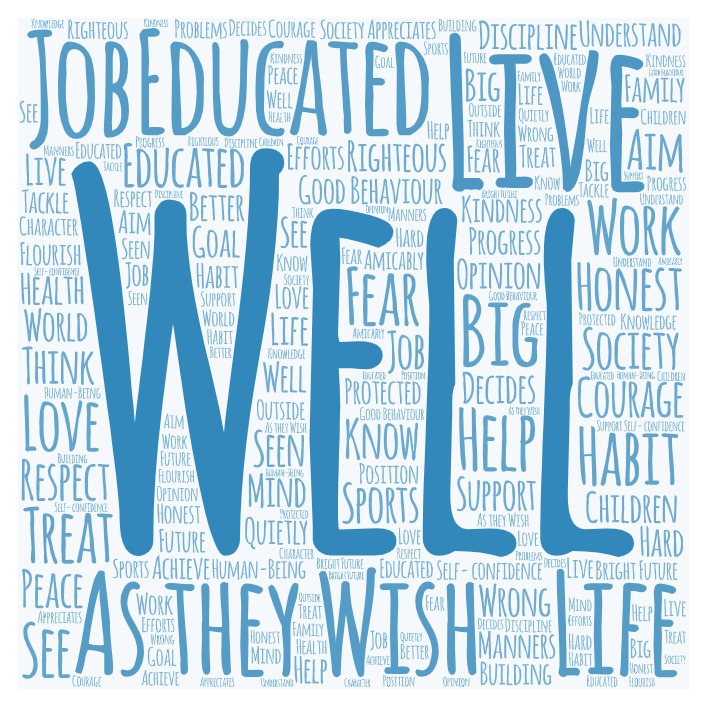
3. What are your aspirations for your child?
Based on the reponses, the first picture depicts the word which was often used and second picture shows how many times it was used.
As the word cloud depicts most of the parents just wish their children would, “Live well”. We need a deeper discussion around this. Other responses include, “Study well”, should have Panbu, Ozhukam (Kindness, good behaviour) and be honest.
Kids aspirations were specific to careers and Jobs and it was mainly traditional choices of Engineer, police, teacher etc and were influenced by their interests media, parent expectations and sometimes the need to earn money for the family and support them.
Observations: I presumed parents would respond more by saying they should get a job or earn more money because the families are from low- income households. But, aspirations were more value-driven and this needs to be discussed among parents, school management and teachers whether the education provided in the school aligns with the aspirations of parents and students.
4. Are you aware of the mental and physical changes your child goes through during adolescence?
Most of the parents said that they are very well aware of the changes that happen to children during their adolescence.
Students response: It was seen that the girls’ knowledge about periods was informed more by the societal myths, and not facts. However, boys as old as 15 and 16, had only a vague idea about it. Girls expressed discomfort in talking about menstruation in front of boys, and in this regard, younger girls from 7th and 8th grade were more uncomfortable than the older ones. Although we discussed the taboo around periods at home, they were habituated to it to an extent where they expressed that they are least affected by it.
Most students, boys and girls alike were completely ignorant or reluctant to talk about what boys undergo during puberty. Each class’s awareness about menstruation and puberty was connected to how it was taught by their teachers. Some teachers have taught the students the facts while most of them resorted to analogies with flowers and animals and have rushed through the topic.
Observations: Teachers are familiar with biological changes of body during puberty but the discussions and knowledge around psychological and behavioural aspects of teens are limited in school.
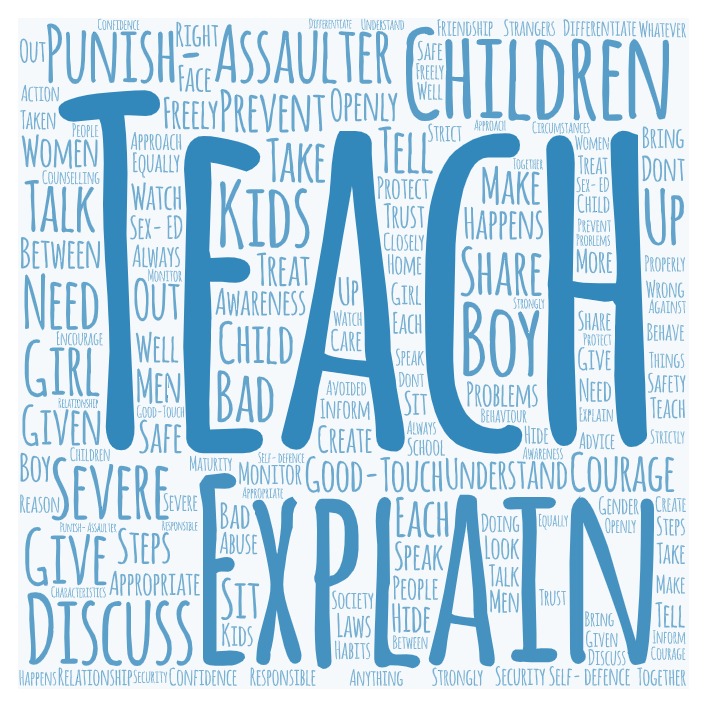
5. How do you think we can prevent child abuse?
Based on the reponses, the first picture depicts the word which was often used and second picture shows how many times it was used.
Parents thought children need to be taught and said this should be discussed. Other responses include that assaulters should be punished and boys need to be taught.
“Sex ed should be explained to both girl and boys and the characteristics should be explained to prevent this”, “We should freely and openly discuss everything with children”,
“We should teach the boys at home and the boys we know about women safety”,
“Should explain to children how different people approach differently and should teach them about good touch and bad touch”,
“Both the kids-boys and girls should be brought up with kindness”
Students responses mainly ranged from not knowing what to do to demanding brutal punishments like, “being burnt alive, kill him, hang him”. The next popular suggestion was to have CCTV cameras. Although, after our workshop, during Post surveys children responded differently by quoting POSCO act or calling for workshops.
Observations: Media has a major role in influencing children on these issues. Most of them had stated news and movies as the source of information for knowing about child abuse. During the workshop, parents were enthusiastic to know more and demanded these discussions be held regularly.
6. What’s the role of teacher and parents?
Parents felt both teachers and parents have an equal role in having these discussions. They suggested that students are more attentive when teachers tell them these things and also a few parents suggested they are responsible for creating a friendly atmosphere at home.
Students expressed more confidence in parents and friends compared to teachers for the question, “Who would you confide in?”
Observations: Except for a few teachers, there is a huge mistrust among teachers and students around these discussions. We need constant engagement among teachers and students around these issues.
7.Are men and women treated equally?
47% of respondents felt men and women aren’t treated equally. While 35% of them felt they are treated equally and 18% didn’t respond to the question.
“Yes, women are in all the fields,Now they are treated equally,
No, But women aren’t any less to men
No, When I was brought up it was different. Now it is different. There is a gap in understanding this
No, I am being a slave and I don’t want my daughter to be like that“
8. Should we have discussions in school around these topics- Adolescence, Love/ Relationships, Sex education and Child abuse?
We had asked this question to 76 respondents,
Observations: More than 70% of the respondents feel it is important to discuss about Adolescence,Love ,sex ed and child abuse in classrooms. I was surprised by this response and I didn’t think so many of them would think Sex Ed is important that needs to be discussed. Teachers felt these topics need to be discussed too but felt they would be uncomfortable to do it themselves. Management was hesitant to ask these questions.
Was the workshop useful? And, Give suggestions
All the parents (100%, I know how this sounds!) felt the workshop was very useful and shared these comments,
“We could have such workshops twice or thrice in a year
I feel students would understand you easily compared to us
We need more discussions about this
A lot of new info was shared. Shouldn’t be one- off exercise. Should be continuous. It needs to be repeated to enforce it, Whatever we hear often is what gets registered, whether it’s good or bad
Younger generations need higher thoughts
Combined-studying should be encouraged and without any gender difference they should sit together and study
Girls and Boys should mix without any differences. And, one shouldn’t make of the other and these things should be taught to children
Should have a meeting with both children and parents. Teachers also.“
Based on my experiences in the last year, I am revisiting so many of my assumptions. I didn’t think people would be open to talking about these topics around gender or climate change. But, based on my conversations, I think a lot of them are curious and want to know more and are willing to listen more. Like my town, Kumbakonam, there are hardly any forums where ideas are publicly exchanged and debated especially not for women. We have only religious events and that’s not interactive too. The initial reaction could be mixed but I think if we design the conversations in the way that is familiar to them, it can be pushed to have meaningful conversations. For example, I started the gender workshop by talking about careers, jobs and mental health before addressing the gender discrimination at the household level. It requires some tweaking but most of us never get a chance to be part of discussions where possibly new ideas are shared and discussed. Most of the people I meet in my town and cities too have never had any chance to have informed public discussions. These kinds of conversations around politics, gender, caste, religion can’t be restricted to classrooms or watching videos or social media interaction. Gender is not an isolated issue, it very much exists with other issues in our communities. I see talking about talking gender as an opportunity to talk other things too.
We need real spaces where communities can deliberate on issues which matter to them and this need to go beyond even less popular institutions like Gram Sabhas. I strongly feel these lack of public spaces, conversations and representation are perhaps the main reasons behind why our democracy is under attack; Because it doesn’t exist in our imagination and most of us have never experienced it in our lives.
It’s been exactly a year since Vaishnavi and I started brainstorming about starting gender sensitisation workshops in her school in Kumbakonam. Now, after an year, when we have completed sessions for over 500 students, 60 teachers and 100 parents, it feels necessary to look at where it all started from and whether it has met our expectations. What prompted this idea as far as I remember was one of our usual discussions on sexist tropes in cinemas, and how it encourages and almost glorifies harassment. This led to more discussions to lack of awareness about gender concepts and sexist stereotypes in text books and complete absence of any form of sex education in our schools.
This led us to read up on gender theories, ideas syllabuses from other similar initiatives across the world. With discussions over phone and mails, we finally created a syllabus for the students for the school. At this point, this was more like a list of topics we needed to cover such as gender roles, stereotyping, menstrual taboos, child abuse and more, and soon we had to segregate and customise them for students, parents and teachers.
By June end last year, we had our first session with teachers, most of whom were women. The session left us with many lessons on how to better our approach. The responses from teachers were supportive. Rather than a resistance to the new ideas we had presented we were welcomed with a qualm that they never had any platform till now to express and discuss these concerns. By July, we initiated our sessions with the students covering those from 7th std to 12th Std. They opened up about their own stories of being discriminated, their perspectives and even instances of being abused.
I would travel to Kumbakonam now and then and Vaishnavi organised sessions on constitution, caste and theatre along with the sessions on gender and sexual harassment. It was amazing to see these children, who were shy and hesitant in the beginning, open up and voice their opinions and assert their identity quite openly over a period of time. At the end of each session we did our survey and feedback exercises. Reading those feedbacks were the most entertaining part of the day for us – it ranged from honest confessions about their prior ignorance on topics concerning all things gender, to really quirky questions and queries to the very pleasing and ego boosting compliments for the beautiful akkas (the last one was far and few in between, nevertheless it did boost our fragile egos!).
In October, we decided to finally conduct an art workshop for the kids. And I was given the responsibility to create along with the students, a giant mural in the school hall. Having never done this before, I was nervous about this ordeal. But I was welcomed with a vast set of paintings – abstract, imaginative drawings and doodles that the kids had drawn. We had asked them to draw anything that would represent the world of their dreams and they responded with their art works on alternative universes, utopian societies where animals conversed openly with humans, and a world where there was no stereotyping.
At the year end, we were left with piles of papers of data to analyse. This didn’t seem like that interesting exercise, and with just two of us in the team, we had no one we could delegate this boring work to. But at the end of looking at the data from over 500 kids, we were amazed and humbled at the response we had seen.
We conducted the workshop for roughly 600 students and around 400 children participated in the pre and post workshop surveys.
At the end of our first phase of gender sensitisation workshops, we have seen that awareness among kids about the concept of gender grew by more than 50 %.
It is quite satisfying to know that the awareness about laws related to sexual harassment and child abuse grew from 23% to 64%.
Along with awareness one of our focal points through these sessions was to observe and affect the perceptions of these communities about gender roles, socialisation and stereotypes.
At the beginning of the sessions, more than half of the students believed that boys are stronger than girls. This came down to 35 % towards the end, with most students responding in fact that boys and girls are equal.
In the pre-surveys, more than three-fourth of the participants(77%) believed that boys cannot be sexually harassed. By the end of the workshops, only 38% still went by this belief.
It is also worthwhile to note that responses of children, teachers and parents were alike in questions that tested their perceptions and social conditioning, reminding us how important childhood interventions of these kind are.
Some perceptions like who is responsible for an event of sexual assault were hard to shake even with informative sessions like ours. Most students and teachers considered both parties – assaulter and the survivor to be at some fault in an even of sexual assault. By the end of the session, most children and some teachers responded that assaulter is solely at fault in this case. These were some of the most challenging topics while taking the session.
It was really encouraging to see more children open up about their own experiences of discrimination, abuse and exploitation. It was heart-breaking to know that more than 12% of our participants had experienced some form of sexual harassment in their life. Some of the responses detailed the places and the people they were scared of, like relative’s house, roads and public places. We had long conversations in the class about child abuse laws, statistics and helplines with the children. These dialogues, though often uncomfortable we need to observe and see how this evolves.
Observations- Teachers Survey
More than 60 % of the teachers who had participated in the workshops agreed that teachers pay more attention to boys than girls.
45 out of 62 respondents believed that sex education is extremely necessary in the school education system.
50 % of the respondents believed that women make better teachers than men.
At the beginning of the session close to 40% teachers thought that boys cannot be harassed which went down to 10 % by the end of the workshop.
Like students, over half of the respondents in the teachers’ workshops believed that both parties are to be blamed in the event of sexual harassment and this came down considerably during the course of the workshop. Most teachers responded that they will be shy, uncomfortable and hesitant to talk about sexual harassment to their students. Some stated that they receive hardly any training to broach these sensitive topics.
20 out of 62 teachers admitted that they have had someone close to them includingstudents share about an experience of sexual harassment they had faced. When asked how would they respond in case if someone was to share such a story with them, responses ranged from listening wholeheartedly to some admitting that they would avoid interacting with that person.
At the end of one year, I believe we have learned much more than the wisdom we sought to impart. We learned about how strong social conditioning can be on the perceptions and attitudes of both children and adults alike, we saw that media especially Tamil movies has an extremely strong influence on the gender perspectives and thought processes of the children, we learned that teachers are often restricted by their own ideologies and limited resources to intervene and influence children positively. We saw that even with the slightest input, children responded in the brightest, exuberant and emotive fashion and it was a joy to see them open up and embrace their identities and stretch their aspirations. Our children went on to initiate clubs on discussing climate change, organised extensive surveys on garbage collection system in the town, and went on to receive praise and accolades for their efforts. Most importantly, these sessions made us confront our own insecurities and ideologies, and be constantly challenged in the process while also exposing us to the complex realities which we work with. It has been humbling, satisfying, frustrating but also made us more empathetic and compassionate in our lives.
May 17, 2020, 4 pm: A volunteer with the Stranded Workers Action Network (SWAN) gets a call from Sanoj. He is one among 15 migrant workers who had vacated their rented rooms in Bengaluru on May 10, hoping to return to their home states – in his case, Jharkhand.
Sanoj recounts in Hindi that, when they went to the Attibele police station to register for a possible train – each police station has been given a quota of tickets for trains – the police chased them away saying that their turn was yet to come. Attibele is an industrial centre under Bengaluru Urban, where the migrant workers were working prior to the lockdown.
Then, Sanoj said, they returned to their rooms to only to find out that they had been evicted by their landlord. Left with no option, they decided to stay on the pavement outside a hospital in Bengaluru near the police station until their turn came.
It has been a week since they started living on the pavement and Sanoj says he is running out of cash and has no access to food.
Sanoj and his group on the roadside where they spent a great deal of time after being evicted by their landlord. Photo: Author Provided
5.30 pm: After transferring some cash into his account, SWAN locates a shelter for the group, 30 kilometres away. It is the nearest one that could accommodate them.
8.35 pm: After trying for hours, SWAN is finally able to find a person willing to help transport them to the shelter. But the workers are anxious about moving so far away from the police station.
As there is no token or wait-list system in place, they are worried that they might miss their turn when the police call to confirm their travel. Anyone can be given the golden ticket any time.
Besides, the workers usually have less than 24 hours to prepare after they get confirmation about their travel. So, they decide to stay on the pavement close to the police station. Six of them move away after spending a week on the pavement to find a roof for the night as they have children with them.